Evaluating Taskboard - Task Dashboard UI UX KIT for Professional Workflow Design
In the rapidly evolving landscape of digital product development, the efficiency of the design phase often dictates the speed and quality of the final delivery. For product managers, UI/UX designers, and development teams, selecting the right foundational resource is a critical decision that impacts project timelines and user experience consistency. Taskboard - Task Dashboard UI UX KIT has emerged as a significant tool in this space, offering a comprehensive suite designed to streamline the creation of task management interfaces. This article explores the capabilities, structural integrity, and practical applications of this kit, providing a balanced perspective on how it fits into modern design workflows compared to building from scratch or utilizing alternative resources.
Understanding the Core Value of Taskboard
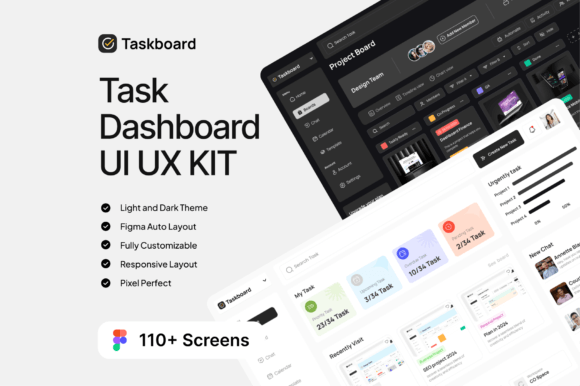
At its essence, Taskboard - Task Dashboard UI UX KIT is a pre-designed collection of interface elements specifically tailored for building task management dashboards. Unlike generic template packs that offer a single aesthetic, this kit focuses on the functional complexity required by project management tools. It provides 110 distinct screens, covering everything from initial login flows to complex Kanban boards, calendar views, and reporting analytics. The primary value proposition lies in its ability to reduce repetitive labor. Instead of designing every button, card, and navigation bar from zero, designers can leverage these pre-constructed components to focus on customization and unique user journey mapping.
The distinction of this kit lies in its organization and scalability. In professional environments, disorganized files are a common bottleneck that slows down collaboration between designers and developers. Taskboard addresses this through a well-organized layer structure within Figma. Every element is named logically, ensuring that when a developer inspects the code, they encounter clear identifiers rather than cryptic labels. Furthermore, the inclusion of both Dark Mode and Light Mode variants acknowledges the current industry standard where users expect seamless transitions between themes based on their device settings or personal preferences. This dual-mode capability is not an afterthought but a core feature, saving hours of manual recoloring and adjustment.
Comparing Pre-Built Kits Against Custom Development
When evaluating whether to use Taskboard - Task Dashboard UI UX KIT or to build a dashboard interface from scratch, several factors come into play. Building from scratch offers unlimited creative freedom and ensures that every pixel serves a specific, unique business need without any legacy constraints. However, this approach is time-intensive. Creating a cohesive system with 110 screens, responsive breakpoints, and accessible color palettes can take weeks or even months for a single designer.
In contrast, adopting a robust kit like Taskboard accelerates the timeline significantly. It allows teams to reach a high-fidelity prototype stage much faster, facilitating earlier user testing and stakeholder feedback. The trade-off here is potential homogeneity; if too many products use the same base kit without sufficient customization, they may begin to feel similar. However, because this kit is fully customizable with easy-to-change colors and vector-based assets, the risk of a generic look is mitigated provided the team applies their own brand identity effectively. For startups needing to launch an MVP (Minimum Viable Product) quickly, or established companies managing multiple internal tools, the speed-to-market advantage of using a structured kit often outweighs the marginal benefits of total custom construction.
Technical Flexibility and Figma Integration
A critical component of any modern design resource is its compatibility with current design software standards. Taskboard - Task Dashboard UI UX KIT is built natively for Figma, leveraging the platform's powerful features such as auto-layout, components, and variables. This ensures that the kit remains future-proof as Figma updates its engine. The "Figma 100" designation implies full vector editability, meaning that illustrations and icons are scalable without loss of quality. This is particularly important for responsive website designs where assets must render crisply across various screen sizes, from mobile devices to large desktop monitors.
Furthermore, the inclusion of a guide for design system compatibility suggests that this kit is not just a static set of images but a modular system. Teams can integrate these components into their existing design systems, maintaining consistency across different products. The use of free Google Fonts also removes licensing barriers, allowing organizations to deploy the design without worrying about font copyright issues. This attention to technical detail makes it a practical choice for teams that prioritize maintainability and scalability over one-off visual flair.
Assessing Strengths and Potential Limitations
The strengths of Taskboard - Task Dashboard UI UX KIT are evident in its comprehensiveness and usability. With 110 screens, it covers a vast array of scenarios typically found in task management applications. Whether the requirement is a simple to-do list or a complex Gantt chart with dependency tracking, the kit likely includes a relevant starting point. The organized naming convention and layered structure facilitate smooth handoffs to development teams, reducing the friction that often occurs during the implementation phase. Additionally, the responsive nature of the design ensures that the resulting application will function well across different devices, a non-negotiable requirement in today's multi-device ecosystem.
However, there are limitations to consider. While the kit is highly customizable, it still operates within a certain design language. If a project requires a radically unconventional interface—such as a gamified workspace or a highly experimental data visualization style—the standard components of Taskboard might require extensive modification to fit the vision. In such cases, the time saved initially could be consumed later by deconstructing and rebuilding components to break away from the kit's inherent aesthetic. Additionally, while the kit supports dark and light modes, the transition logic and specific accessibility contrasts must still be verified against strict WCAG guidelines by the design team, as pre-built kits do not always guarantee perfect compliance out of the box.
Determining the Best Fit for Your Project
Deciding when to utilize Taskboard - Task Dashboard UI UX KIT depends largely on the project's goals, timeline, and scope. This resource is an ideal choice for:
- Startups and MVPs: Teams that need to validate a concept quickly and have limited design resources will benefit immensely from the ready-made screens and rapid prototyping capabilities.
- Internal Tools: Companies building internal dashboards for employee productivity often prioritize functionality and speed over unique branding. The clean, professional look of this kit suits these needs perfectly.
- Agile Teams: Organizations operating in sprints can use the kit to deliver high-fidelity designs within a single iteration, allowing for faster feedback loops.
- Designers New to Dashboards: For professionals less experienced in complex data visualization or workflow design, the kit serves as an educational reference for best practices in layout and information hierarchy.
Conversely, you might consider alternative approaches or building from scratch if:
- Your brand identity relies heavily on unique, non-standard visual metaphors that cannot be easily adapted from standard UI components.
- The project involves highly specialized hardware integrations where the UI requirements deviate significantly from standard web or mobile patterns.
- You have a large, dedicated design team with ample time to invest in creating a proprietary design system from the ground up.
Practical Implementation Strategies
To maximize the utility of Taskboard - Task Dashboard UI UX KIT, it is advisable to treat it as a foundation rather than a final product. Begin by auditing the 110 screens to identify which ones align with your specific user stories. Remove unused components to keep the file lightweight and focused. Next, apply your brand's color palette and typography. Since the color changing process is streamlined, this step should be quick. However, ensure that you test the contrast ratios, especially in Dark Mode, to maintain readability.
Because the kit is fully customizable, teams can extend its capabilities by adding new components that address niche requirements. The well-organized layers make it easy to understand how existing components are constructed, allowing designers to replicate the logic for new elements. This hybrid approach—using the kit for standard patterns and customizing for unique needs—often yields the best balance of speed and uniqueness. By leveraging the responsive website features included, designers can also ensure that the layout adapts fluidly, testing breakpoints early in the process to avoid costly rework during development.
Conclusion on Resource Selection
Selecting the right design resource is a strategic decision that balances time, cost, and creative control. Taskboard - Task Dashboard UI UX KIT offers a robust solution for those seeking to accelerate the development of professional task management interfaces. Its comprehensive screen count, dual-mode support, and Figma-native architecture provide a solid foundation for efficient design workflows. While it may not suit every single project—particularly those requiring radical deviation from standard UI patterns—it represents a highly effective tool for the majority of commercial and internal applications.
By understanding its strengths, recognizing its limitations, and applying it strategically, design teams can significantly reduce overhead while delivering high-quality, user-centric products. Ultimately, the value of Taskboard lies not just in the assets it provides, but in the time it frees up for designers to focus on solving real user problems rather than drawing basic interface elements. For teams aiming to optimize their design process without compromising on quality, this kit stands as a compelling option in the current market landscape.