Cookbook Template Recipe Book Design for Professional Results
Creating a high-quality cookbook requires more than just collecting recipes and taking photographs. It demands a structured approach to layout, typography, and visual hierarchy that ensures the final product looks polished and professional. This is where a dedicated Cookbook Template Recipe Book Design becomes an essential asset in your creative workflow. Rather than starting from a blank page, which can lead to inconsistent formatting and wasted hours on alignment, utilizing a pre-designed framework allows you to focus on content curation and storytelling. For chefs, food bloggers, publishers, and small business owners, this tool bridges the gap between raw content and a market-ready publication.
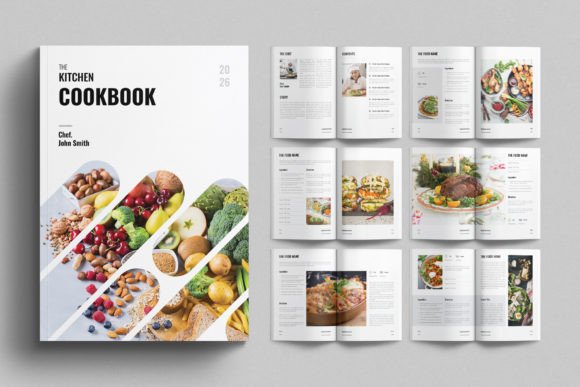
The core value of a robust template lies in its ability to standardize the design process. When you work with a 16-page Cookbook Template Recipe Book Design, you are leveraging a system built by experts who understand the nuances of print production. These templates are typically created for Adobe InDesign, the industry standard for desktop publishing. By adopting such a template, you integrate a layer of professional precision into your project immediately, ensuring that margins, grids, and style guides are already established. This not only accelerates the timeline but also significantly reduces the risk of costly printing errors.
Integrating Templates into Your Creative Workflow
Understanding how to fit a template into your broader project lifecycle is crucial for efficiency. The integration of a Cookbook Template Recipe Book Design usually happens after the initial content gathering phase but before the final proofing stage. Before opening the software, it is beneficial to have your text finalized and your images selected. A template does not replace the need for good content; rather, it provides the vessel in which that content lives.
Once you begin the actual design phase, the template acts as a scaffold. You can drop your recipes into pre-defined character and paragraph styles, ensuring that every heading, ingredient list, and instruction block maintains consistent spacing and font weight. This consistency is often difficult to achieve manually, especially when working under tight deadlines. The template handles the technical constraints of the page, allowing you to concentrate on the aesthetic flow of the book. Whether you are designing a personal gift, a marketing brochure for a restaurant, or a commercial publication for sale, the workflow remains similar: prepare assets, import them into the grid, and refine the details.
Technical Compatibility and File Management
One of the most practical considerations when selecting a design resource is software compatibility. A well-constructed Cookbook Template Recipe Book Design accounts for the diverse versions of Adobe InDesign currently in use. To ensure broad accessibility, these templates often come in multiple file formats, including .INDD for current Creative Cloud (CC) users, .INDT for legacy CC versions, and .IDML for older versions like CS4, CS5, and CS6. This multi-format availability ensures that whether you are on the latest subscription model or maintaining an older workstation, the file will open without corruption or missing elements.
Furthermore, the physical specifications of the template must align with your printing requirements. Most professional templates offer two standard size options: International A4 and US Letter. These dimensions cover the vast majority of self-publishing and commercial printing needs. Additionally, the inclusion of a 3mm (0.125 inch) bleed is a critical detail often overlooked by beginners. Bleed ensures that when the printed pages are trimmed to their final size, there are no white edges left around the border. Having this pre-configured in the Cookbook Template Recipe Book Design saves significant time during the pre-press preparation phase.
Customization and Brand Consistency
A common misconception about using templates is that they result in generic-looking products. However, a high-quality Cookbook Template Recipe Book Design is built to be fully editable, allowing for deep customization that aligns with your specific brand identity. The template comes with a premade neutral color palette, which serves as a safe starting point for modern and elegant concepts. More importantly, these colors are linked to swatches that can be changed globally. If your brand uses specific hex codes or CMYK values, you can update the master palette, and the change will propagate throughout the entire document instantly.
This "one-click" color adaptation is a powerful feature for entrepreneurs and marketers who need to maintain brand consistency across various materials. Instead of manually recoloring every shape, line, and text element, you simply modify the swatch library. The same principle applies to typography. While the template utilizes free fonts to keep costs low, these fonts are linked within the help file, making them easy to install and manage. If you wish to swap the typeface for a licensed font that better suits your brand voice, the organized layers allow you to do so without disrupting the layout structure.
Organizational Structure and Layer Management
Efficiency in design is heavily dependent on how well the file is organized. A chaotic file with overlapping objects and ungrouped elements can turn a simple edit into a nightmare. The Cookbook Template Recipe Book Design addresses this by strictly organizing all elements into separate layers. Typically, you will find distinct layers for images, text, and background elements. This separation allows you to toggle visibility or lock specific layers while working on others, preventing accidental moves or deletions.
Moreover, the alignment to a grid system ensures that every element sits precisely where it should. Grids are the invisible backbone of professional design, creating rhythm and balance across pages. When you place a new recipe or image, snapping it to the existing grid maintains the visual integrity of the spread. This structural discipline is particularly useful when collaborating with other team members. If you hand off the file to a copy editor or another designer, the clear layer structure makes it easy for them to understand the hierarchy and make necessary adjustments without breaking the layout.
Quality Control and Print Preparation
Before sending any document to a printer, rigorous quality control is mandatory. Using a professionally designed template simplifies this process because many potential pitfalls are already resolved. The color mode is set to CMYK, which is essential for offset and digital printing. Working in RGB can lead to significant color shifts once the file is converted for print, often resulting in duller or inaccurate hues. By starting with a CMYK-based Cookbook Template Recipe Book Design, you ensure that the colors you see on screen are much closer to the final printed output.
Additionally, the inclusion of Master Pages streamlines repetitive tasks. Elements like page numbers, headers, footers, and decorative borders can be placed on a Master Page. Any changes made to the Master Page automatically update across all pages linked to it. This is invaluable for maintaining consistency and correcting errors. If you realize the page number font is too small, you fix it in one place, and the entire book updates instantly. This level of automation reduces human error and ensures a uniform look from the first page to the last.
Practical Implementation Tips
To get the most out of your Cookbook Template Recipe Book Design, consider the following implementation strategies. First, always read the included help file. This document contains vital information regarding font links, usage instructions, and troubleshooting tips. Second, take advantage of the separate layers to experiment with different layouts. Try moving images to different positions or swapping backgrounds to see what best complements your specific recipes. Third, remember that while the template provides the structure, your photography and writing are the stars of the show. Invest time in high-resolution images and clear, engaging text to maximize the impact of the design.
Finally, view the template as a flexible tool rather than a rigid constraint. While it is designed for a 16-page format, the principles and styles can often be adapted for longer books by duplicating and modifying pages. The goal is to create a seamless experience for the reader, where the design supports the content without distracting from it. By integrating this resource into your workflow, you gain a competitive edge in terms of speed, quality, and professionalism. Whether you are launching a new culinary brand or preserving family recipes, a well-executed design is the foundation of a successful publication.