SaleBoard - Sale Dashboard UI UX KIT: A Practical Evaluation for Professional Dashboards
In the landscape of digital product design, the efficiency of a workflow is often determined by the quality of the foundational resources used. For designers tasked with creating complex data visualization tools, the SaleBoard - Sale Dashboard UI UX KIT presents a structured approach to building sales analytics interfaces. This resource is not merely a collection of graphics but a comprehensive system designed to streamline the creation of responsive dashboards across various devices. Understanding its capabilities, limitations, and comparative value is essential for professionals deciding whether it fits their specific project requirements.
Understanding the Scope and Structure of SaleBoard
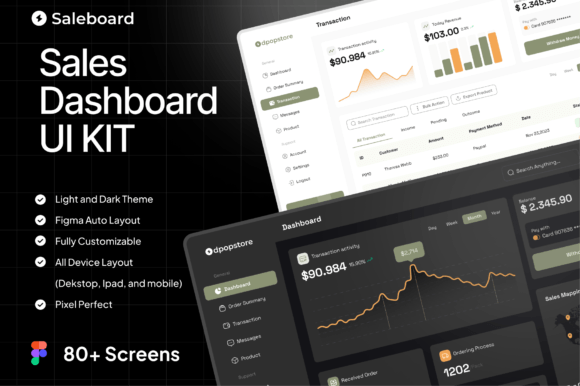
The primary function of the SaleBoard - Sale Dashboard UI UX KIT is to provide a ready-made framework for sales dashboard development. At its core, this kit offers 80 distinct screens, covering a wide array of data presentation needs typical in business intelligence applications. These screens are not static images; they are fully editable vector components built within the Figma ecosystem. This ensures that every element, from the smallest icon to the most complex chart, remains scalable without loss of quality.
A defining characteristic of this kit is its organizational structure. In many design projects, time is lost navigating through disorganized layers or renaming elements. The SaleBoard addresses this by implementing a rigorous naming convention and layer hierarchy. Each illustration and component is clearly labeled, allowing designers to locate specific assets quickly. This level of organization is particularly valuable when working on large-scale projects where multiple team members might access the file simultaneously. Furthermore, the kit supports both Dark Mode and Light Mode configurations, a critical requirement for modern applications that must adapt to user preferences and varying environmental lighting conditions.
Comparing Formats: Custom Build vs. Pre-Built Kits
When evaluating design resources, a common decision point arises between building a dashboard from scratch and utilizing a pre-built kit like SaleBoard - Sale Dashboard UI UX KIT. Building from zero offers complete creative freedom but demands significant time investment. Designers must create every button, graph, and layout grid, ensuring consistency manually. In contrast, using a kit accelerates the prototyping phase significantly. With 80 pre-designed screens, the initial layout work is largely completed, allowing the designer to focus on customizing the data logic and specific branding elements rather than fundamental UI construction.
However, relying on a pre-built solution does come with tradeoffs. There is a risk of visual homogeneity if the kit is used without sufficient customization. While the SaleBoard allows for easy color changes and vector editing, the underlying structural patterns may feel familiar to users who have seen similar kits. Therefore, the decision to use this resource depends heavily on the project timeline and the need for unique visual differentiation. For startups needing an MVP (Minimum Viable Product) quickly, or agencies managing multiple client projects, the speed offered by SaleBoard often outweighs the minor risk of generic aesthetics, provided the designer applies a thoughtful layer of brand-specific customization.
Responsiveness and Cross-Device Compatibility
One of the most critical aspects of modern dashboard design is responsiveness. Data needs to be accessible not just on desktop monitors but also on tablets and mobile devices. The SaleBoard - Sale Dashboard UI UX KIT explicitly addresses this by providing screen variations optimized for iPad and mobile formats. This multi-device approach is superior to simply scaling down a desktop view, as it considers touch targets, information density, and navigation flow specific to smaller screens.
Many alternative resources focus primarily on desktop layouts, leaving the designer to manually adapt the interface for mobile use. This manual adaptation can introduce inconsistencies and bugs in the user experience. By including dedicated tablet and mobile screens, SaleBoard ensures a cohesive experience across the entire ecosystem. This is particularly relevant for sales teams who often review metrics on the go. The ability to switch seamlessly between a detailed desktop view and a streamlined mobile summary is a feature that adds tangible value to the final product.
Evaluating Flexibility and Customization Options
The utility of any UI kit is measured by how easily it can be adapted to a brand's specific identity. The SaleBoard kit is built on Figma's robust vector engine, making it 100% editable. This means that colors, fonts, and shapes can be altered without degrading the design integrity. The inclusion of free Google Font compatibility further simplifies the integration process, as designers do not need to source or license additional typography files. Instead, they can leverage a vast library of web-safe fonts that load quickly and render consistently across platforms.
Changing the color palette is often a bottleneck in customizing templates. Some kits hard-code colors into individual layers, requiring tedious updates. In contrast, the SaleBoard - Sale Dashboard UI UX KIT utilizes a system where color variables are centralized. Changing a single variable updates the entire interface instantly. This efficiency is crucial when presenting multiple design concepts to stakeholders or when rebranding an existing application. However, designers should still verify that the chosen color combinations maintain sufficient contrast ratios for accessibility, as the default palettes, while professional, may require adjustment to meet specific WCAG standards.
Decision Factors: When to Choose SaleBoard
Determining whether SaleBoard - Sale Dashboard UI UX KIT is the right tool requires an honest assessment of project constraints and goals. It is an ideal choice for scenarios where time-to-market is a priority. If a team needs to present a functional prototype to investors or clients within days rather than weeks, the 80-screen library provides an immediate foundation. It is also well-suited for freelance designers who manage diverse client portfolios, as the organized layers reduce the learning curve associated with new projects.
Furthermore, this kit is beneficial for teams that lack specialized expertise in data visualization. Creating effective charts and graphs that accurately represent complex data is a skill that takes years to master. The pre-designed components in SaleBoard offer best-practice examples of how to display sales metrics, conversion rates, and revenue trends effectively. This allows less experienced designers to produce high-quality results that adhere to industry standards.
Limitations and Alternative Approaches
Despite its strengths, there are situations where SaleBoard - Sale Dashboard UI UX KIT may not be the optimal solution. Projects requiring highly unconventional interactions or radical departures from standard dashboard layouts might find the pre-defined structures restrictive. If a product aims to redefine how users interact with sales data, starting from a blank canvas might yield more innovative results than adapting an existing template.
Additionally, while the kit covers a broad range of standard sales scenarios, niche industries with unique data requirements might find gaps in the available screens. In such cases, designers may need to supplement the kit with custom-built components. Another consideration is the cost-benefit analysis. For very small projects or one-off internal tools, the investment in a premium kit might exceed the value gained compared to using free, open-source alternatives or simpler templates. However, for commercial products intended for public release, the professionalism and polish of SaleBoard often justify the expense.
Strategic Implementation for Maximum Value
To get the most out of the SaleBoard - Sale Dashboard UI UX KIT, designers should adopt a strategic implementation approach. Rather than treating the screens as final deliverables, they should be viewed as modular components. Start by auditing the 80 available screens to identify which ones align with the core user journeys of your specific application. Remove unnecessary screens early to keep the file size manageable and the focus sharp.
Leverage the dark and light mode capabilities to conduct user testing under different conditions. This can reveal usability issues that might not be apparent in a single theme. Additionally, take advantage of the organized layer structure to create a design system around the kit. Define your own style guide based on the kit's components, ensuring that any new elements added later match the established visual language. By treating the kit as a dynamic starting point rather than a static endpoint, teams can achieve a balance between rapid development and bespoke design quality.
Ultimately, the value of SaleBoard - Sale Dashboard UI UX KIT lies in its ability to reduce friction in the design process. It removes the burden of foundational layout work, allowing creativity to be directed toward solving actual user problems. Whether you are a seasoned product designer or a developer looking to enhance your UI skills, understanding how to integrate such resources effectively can significantly impact the success of your digital products. As the demand for data-driven decision-making grows, having a reliable, flexible, and well-organized toolkit becomes an indispensable asset in the professional arsenal.